FAQ
All of our commonly asked questions answered…
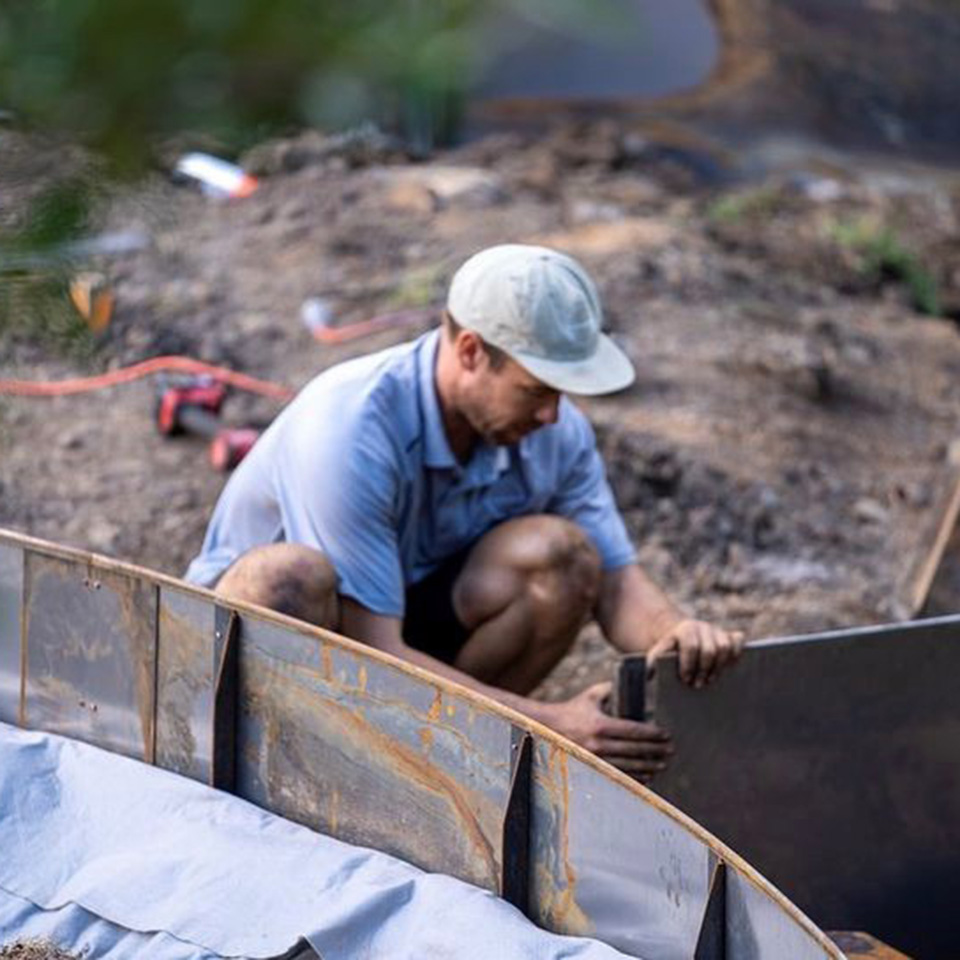
Our manufacturing and head office is located at 53 Jersey Rd Bayswater, Victoria. We have stores located throughout Australia, please use our store locator to find your closest stockist.
We recommend visiting one of our many stockists for advice, most have either a showroom or display area featuring our products. ShapeScaper’s Bayswater location is purely a manufacturing facility, you are however always welcome to speak to our sales team for any product inquiries.
We accept cash, bank transfer and most card payments, except American Express.
If you are not totally satisfied with the condition of our product upon on delivery please contact your stockist immediately to discuss the issue. They may ask you to document the problem with photos and will work with you to resolve the issue ASAP.
Return of product that is not faulty will be at the full discretion of Landscape Engineering Pty Ltd, for any refund to be considered all items must be returned complete and in unused condition. Please note product that has had exposure to moisture may not be in a returnable condition.
ShapeScaper have stockists throughout Australia. If you are outside the areas directly serviced by our stockists, we can ship orders directly to you. Check our store locator for your closest stockist.
No, ShapeScaper are product manufactures. We can however offer advise on product use and it’s suitability based on your design plans.
We don’t recommend any particular landscapers to install our products, however our stockists may have good suggestions for your specific location and style of projects. Alternatively your state based professional landscape associations will have a list of local members who are fully qualified and insured.
ShapeScaper offer a custom fabrication service and our team are happy to work with you on custom designs that are based around our standard product lines. Call us or send through with your specifications and design drawings, we will then prepare a quote for you. Please note all custom work requires a 50% deposit prior to manufacture.
ShapeScaper edging is flexible and will hold its form after being bent. Profile heights of up to 150mm can comfortably be bent on site into sharp bends or stylish curves. Profile heights above this become progressively more challenging to shape on site. Corners can be bent on site using a stake laid across the edging at 90 degrees, positioned at the point where you would like to form a corner. Corners should be at least 300mm from the end of the edging, this allows enough length to lever up the end of the edging using your fingers. Position your feet close to the sides of the edging to secure the stake. Bend the edging back up a little over the required angle, then adjust back to the preferred angle. It’s important to bend corners rather than mitre cutting them as cutting reduces strength and creates sharp edges. Please note we also offer a custom shaping service. We also offer as stock items 90° internal and external corners for all our profiles.
Use your body weight to gently and gradually bend the edging. Hold the end of the edging up with one hand while running your other hand along the edging with downward pressure to form the curve. Work in small increments, slowly adding to the shape of the curve. If you over-shaped a curve simply apply pressure in a similar way from the other side to reduce the radius of the curve and maintain the correct line.
2.0mm edging is as easy to shape as 1.6mm but less likely to kink on tighter curves.
There are however some limitations when shaping by hand:
75-185mm can relatively easily be shaped by hand to a radius of 500-700mm
230-290mm can relatively easily be shaped by hand to a radius of 600-800mm
390 – 590mm can relatively easily be shaped by hand to a radius of 700-900mm
You can hand shape tighter radii, but proceed with care. If forced too tight too quickly, you can create a kink in the curve, and they are difficult to repair. You can pry the kinked lip out gently with a flat blade screwdriver if they do occur, but that piece of edging will always bend on that point if forced tight again.
For tighter curves and higher profiles ShapeScaper provides a custom machine rolling service that can shape profiles from 75mm – 590mm down to a radius of 200mm.
The easiest way to describe a simple curve is to establish the radius and the length of the arch. Using a fixed point and a string or tape measure, you can determine these measurements:
1. Radius: Measure from a center point between ends of the curve to points along the curve. This should be a constant number for each curve.
2. Arc length: Measure along the curve from one end to the other.
For more complex curves, you may need to break them down into smaller sections and measure each separately. When ordering ShapeScaper products for a custom curved design, providing these measurements will help ensure you get the right amount of material for your project.
External corners have the lip facing in and are used for raised features. The less commonly used Internal corners have the lip facing out and are used for“sunken” features.
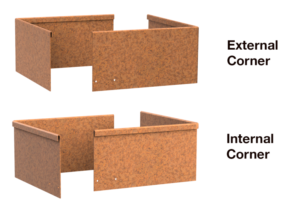
ShapeScaper edging lengths are all 2400mm long. The corner pieces are 300mm on each side.
Redcor looks a silver/grey colour before being exposed to moisture, in fact it has a thin layer of oil covering the surface to help stop any oxidation (rust) from forming prior to installation. Keeping the steel like this prior to installation helps with storage and handling. It also ensures that once the product is installed the rust patina that forms is truly reflective of your environment.
One of the main advantages of all ShapeScaper products is the ease of installation. Both our edging and planters are supplied with pre-drilled alignment holes along with the fittings and fasteners required. No specialist tools are necessary, however the following tools are often used when installing edging.
– string line
– spray marker
– level
– tape measure
– marking pen
– shovel and mattock
– rubber or Dead blow hammer hammer
– impact driver
– 5/16 or 8mm hex bit
– small pry-bar
– vice grip clamp
– angle grinder
– thin “stainless steel” cutting discs
– pop rivet gun
– drill and 5.0mm bit
– safety glasses
– hearing protection
– gloves
– knee pads
All ShapeScaper products come with predrilled holes and all the necessary screws, rivets, stakes and connector plates to join and assemble the products. Line up the pieces so the holes match up, then simply screw together using the supplied screws and an impact driver.
All edging installations require appropriate ShapeScaper stakes to achieve the best results.
ShapeScaper modular planters, rings and three ring tiered planters usually don’t require stakes. Rings of all profile heights with a diameter of 1530mm or less usually don’t require stakes unless they are positioned on slope and need levelling. Larger diameter rings, especially with larger profile heights should always be secured with stakes.
All edging installations require three or four stakes per edging length. Four stakes per length are preferred when installing steps and long straight runs especially in sandy or unsettled soils. Three stakes per length are sufficient in clay soils and edging featuring curved runs.
The following lists the appropriate length stake for each edging profile.
– 75mm x 2400mm edging requires (3 or 4) 230mm stakes
– 100mm x 2400mm edging requires (3 or 4) 300mm stakes
– 150mm x 2400mm edging requires (3 or 4) 400mm stakes
– 185mm x 2400mm edging requires (3 or 4) 400mm stakes
– 230mm x 2400mm edging requires (3 or 4) 450mm stakes
– 290mm x 2400mm edging requires (3 or 4) 580mm stakes
– 390mm x 2400mm edging requires (3 or 4) 780mm stakes
– 590mm x 2400mm edging requires (3 or 4) 1180mm stakes
The lower profile stakes 230mm, 300mm and 400mm can be hammered into place using a rubber mallet. For even better results use a “dead blow” hammer. Care should be taken not to damage the top of the stake which may prevent the stake fitting correctly under the edging lip. If a mash or sledge hammer is used a block of wood or similar should be used to protect the top of the stake.
Higher profile stakes can be driven into soft ground in a similar way to the lower profile stakes. In firm ground our stake driving tool can be used.
A stake driving tool is available when installing 580mm, 780mm and 1180mm stakes. Please call sales for further details.
In rocky or hard ground and especially with the longer 780mm and 1180mm stakes a 150mm-200mm diameter hole should be augered then back filled with concrete. Stakes should be coated with a bitumen paint when in contact with concrete. Use a layer of plain gravel at the base of each hole to allow for drainage.
FYI:
One 20kg bag of ready mix concrete makes approximately .01 m3 in volume
Volume of concrete required per hole:
@ 150mm diameter hole
For depth 400mm ~ 0.0071m3
For depth 500mm ~ 0.0088m3
For depth 600mm ~ 0.0106m3
For depth 700mm ~ 0.0124m3
For depth 800mm ~ 0.0141m3
@ 200mm diameter hole
For depth 400mm ~ 0.0126m3
For depth 500mm ~ 0.0157m3
For depth 600mm ~ 0.0188m3
For depth 700mm ~ 0.0220m3
For depth 800mm ~ 0.0251m3
ShapeScaper planters boxes are generally self supporting, however planters may include additional cross bracing to add extra rigidity especially where extender panels are used.
The Redcor weathering steel ShapeScaper use in our planters is safe to plant out with vegetables etc. without any additional liners or treatment. Using a liner or waterproofing treatment on the inside any weather steel product will however greatly help increase it’s life span.
All ShapeScaper planters are supplied without bases, as free draining planters are preferred in most applications. “Drop-in” planter bases are available for most ShapeScaper stock planters. We can also fabricate custom bases with specific drainage points and feet especially suited to patio and roof top applications.
Steel can be powder coated in a range of contemporary colours. Powder coating is however easily damaged, not dissimilar in durability to a car panel. As such it may not be suitable or recommended in a harsh landscape environment.
Alternatively you may consider the application of a product such as “Bridge Paint”. It offers extended corrosion protection and is more forgiving in it’s application than regular paint. It can also be retouched when required.
Redcor steel can safely be welded using the appropriate grade filler for weathering steel. Welding ShapeScaper products on typical installations is unnecessary and may even lead to inferior results. Our modular system is specifically designed to not require any additional on site welding.
The lower holes are not designed to take rivets, they are smaller in diameter to allow the hex head self tapping screws to be firmly secured. Screws should be used for all fittings under-ground while the rivets should only be used for fittings above-ground.
Rivets are supplied to fit connectors and stakes wherever higher profile edging is above ground. The use of rivets with 230mm edging is however optional. All higher profiles should have rivets fitted to all the matching pre-drilled holes found on the connectors and stakes. Rivet holes on the edging are not pre-drilled, as fascia installations may not require riveting. It also leaves the option to place stakes at any point along the edging without leaving extra unused holes. To position the rivet holes along the edging use either a stake or a connector as a template to drill through. (The supplied self tapping screws can be used in place of a 5mm drill bit if needed)
The weathering steel used in ShapeScaper products will begin forming its protective rust “patina” over a couple of weeks and become fully weathered between 6 months and two years, depending on the exposure to moisture. Please note the use of strong acid or salt to accelerate the process will permanently damage the protective properties of weathering steel.
We recommend that the lower profile edging be buried about a third into the ground. This helps add stability and gives a cleaner look to the edging. Screws should be fitted below ground level.
– 75mm edging @ a min depth of 30mm below ground level
– 100mm edging @ a min depth of 30mm below ground level
– 150mm edging @ a min depth of 40mm below ground level
– 185mm edging @ a min depth of 50mm below ground level
– 230mm edging @ a min depth of 70mm below ground level
– 290mm edging @ a min depth of 80mm below ground level
– 390mm edging @ a min depth of 100mm below ground level
– 590mm edging @ a min depth of 150mm below ground level
Steel edging is easy to cut, use a connector as a guide to mark your line. A thin cut off disc designed to cut stainless steel fitted to a cordless grinder will give the best results. Please observe all PPE requirements. Please note the potential of personal risk, power tool users should be suitably skilled and competent. If a grinder is unavailable a hack saw can also be used.
ShapeScaper RedCor weathering steel forms an initial “rust” protective coating that doesn’t allow the rust to penetrate and further corrode the steel. The patina layer of rust protects the steel from further oxidation or “rusting” and will easily reform over any scratches or deep gouges, resulting in zero maintenance!
Weathering steel achieves this by chemically reducing the tendency of rusted or oxidized steel to absorb water and then flake off the main body of unoxidized steel. This protective property is best achieved with alternative cycles of wet and dry conditions.
Continual exposure to moving water in moist acidic conditions will reduce this protective characteristic significantly.
Over time all steel products will eventually oxidize back to state that is similar to the natural “iron ore” from where it was originally manufactured.
Rust staining will occur as “run off” from Redcor planters and edging during the early stages of weathering while the formation of a stable patina occurs, typically over the over the first six months after installation. The rust patina initially forms as a fine powder that sticks to the surface but can leach in small amounts when exposed to heavy watering. This run off is harmless but care should be taken around sensitive aquatic environments.
Any staining should be dispersed regularly by hosing the area clean, a light spraying of the weathering steel will also help speed up the patina process at the same time. A mild solution of white vinegar applied to the run off area prior to washing down can be used for heavier staining.
Care should be taken on porous or lightly coloured surfaces such as marble or travertine. In these situations developing the patina off site is highly recommended and there is an ongoing risk that staining will ocour.
After the rust patina has formed a solid and stable coating there is a reduced risk of further run off but it will still occur under some conditions.
SHAPESCAPER products can be placed almost anywhere, the main benefit of placing them directly on the ground rather than other surfaces is free drainage and unrestricted root growth. Installation on decking or rooftop areas typically require the use of bases and geotextile fabric to prevent the soil from leaching out. Site drainage should be planned in conjunction with the base drainage locations.
To avoid surface damage and allow for adequate drainage planters should be raised up, away from the surface area. Custom feet can be supplied that are suitable for most of our planter range. Please also consider the total wet weight of your planter layout and ensure that your surface structure is suitably rated.
All SHAPESCAPER products are suitable to trim up against using a nylon corded whipper snipper. No matter how deeply scratched, marks made on the surface of Redcor products will in time, return to the original patina. Redcor and ZinMag are self healing and will continue to provide corrosion resistance and a long life even when the surface is heavily scratched with garden tools. Galvabond surfaces may however start to corrode if the surface coating is heavily scratched.
SHAPESCAPER products feature smooth rounded surfaces. The safety lip on SHAPESCAPER edging not only conceals stakes but the helps decrease chance of injury. This is why it’s important to bend corners rather than mitre cutting them. Or simply use pre-bent corners. Redcor Steel and Galvabond Steel are both non-toxic in the environment.
SHAPESCAPER steel edging can help control the spread of couch grass (aka. Bermuda grass), but edging alone may not completely block the grass from spreading. A partial barrier can be achieved with edging placed 100mm below ground, at 300mm below ground the spread of the root system will be significantly reduced. Maintain the border regularly to prevent couch grass from growing over the edging and sending it’s runners out over the adjacent area.
The Glyphosate in these products will not harm or degrade steel edging. However, it’s important to follow the manufacturer’s instructions for application and safety precautions when using any herbicides or weed control products.
When applying these products near your steel edging:
– Avoid overspray onto the edging to maintain its appearance
– Clean any residue off the edging promptly with water
– Be cautious of drift that could affect nearby plants
Remember that while the edging itself is not affected, these products may impact the soil and plants around it. Always use herbicides responsibly and consider alternative weed control methods when possible.
ShapeScaper offers a 10 year structural warranty for all its products however this is voided for installations closer than 1 Km to the coast. Salt air inhibits the corrosion resistant properties of Redcor steel and can result in a reduced lifespan.
There are however many installations of Redcor steel used in coastal locations with very satisfactory results and with a minimal impact on life span. Allowing the protective “rust” patina to develop away from salt air prior to installation will significantly improve improve the corrosion resistance and life span of the ShapeScaper products used.
For extreme environments selecting the 2.5mm thickness in either Galvabond or Redcor will add considerably to the service life of ShapeScaper edging. ShapeScaper stainless steel or a self healing product such as ShapeScaper ZinMag should also be considered.
Self healing Zinc Aluminium and Magnesium (ZinMag) coatings have the best durability of the three and a bright metal finish is maintained over its lifespan. Galvanised coatings offer a more cost friendly corrosion resistance and dull to a light grey finish over time. They are also more susceptible corrosion if the coating is damaged in any way. Redcor weathering steel develops a “rust” coloured patina that can darken to a chocolate brown over time. It offers cost effective corrosion resistance and is maintenance free. It is not a coated steel and the corrosion resistant qualities are built into the steel. If the top protective layer of “rust” is damaged in any way it simply reforms again over time. The patina acts as a barrier, slowing down further corrosion and protecting the underlying steel.
ShapeScaper edging comes in 8 different profile heights : 75mm, 100mm, 150mm, 185mm, 230mm, 290mm, 390mm and 590mm
And three thicknesses :
1.6mm for 75, 100, 150, and 185mm profile heights
2mm for 75mm, 100mm, 150mm, 185mm, 230mm, 290mm, 390mm and 590mm profile heights
2.5mm for 100mm, 150mm, 185mm, 230mm, 290mm, 390mm and 590mm profile heights
Lead times ShapeScaper custom orders usually take up to 10 working days, please confirm with our sales staff our current lead times when placing your order.
ShapeScaper steel edging is stronger, lasts longer, and is much simpler to install than most wooden edging solutions. Quality Jarrah wood, the traditional choice, has now become virtually unobtainable leaving treated pine one of the few options.
While treated pine might be cheap it simply doesn’t remain stable in a landscape environment, shrinkage and warping are common issues along with possible chemical leaching.
All planters will absorb heat from the sun and eventually reflect the ambient temperature of their surroundings. Metal planters will definitely feel hotter to touch because they more thermally conductive than plastic or timber.
The wide range and modular nature of ShapeScaper planters make installation using a minimum of tools extremely DIY friendly. The speed and ease of installation is also a very popular feature enjoyed by many professional landscapers! The pre-drilled holes and the ease of transport make the ShapeScaper range of customisable planters the perfect landscaping design solution.
Lay out the ShapeScaper modular planter boxes, extender pieces and corners sections to the preferred design preferably on a flat surface. Line up the pieces so the holes match up, then simply screw straight through connecting ribs using the supplied hex screws.
Partially secure the top screws first; ensuring that the top 40mm return face is flush. Then fully secure the bottom screws, returning to fully screw the top screws. Complete the process by fully tightening the middle screws bringing the two ribs together until a minimal gap is visible between the exterior surfaces.
ShapeScaper modular planters are self supporting and stakes are not required in typical applications.
ShapeScaper planters are self supporting, larger planters however, may include additional brackets for extra support when required.
We recommend applying a waterproof coating, such as Crommelin Blackseal Heavy Duty bitumen paint, to any inside surface that is exposed to soil. This will helps maximize the lifespan of any weathering steel planter. ShapeScaper steel planters however are manufactured from 2.5mm thick steel and perform well without a coating, many of our customers simply add soil directly to their planters. Good drainage is essential for all planter systems. This can be achieved by using a quality potting mix on top of a free-draining medium like large rocks, broken concrete pieces, gravel, or sand.
A “French drain” can be installed under planter boxes to assist in water disposal if planters are placed on top of non-draining surface such as a hard clay base.
Typically ShapeScaper planters don’t come with a base, if required we can supply a “drop in” base for most of our planter range. Custom bases can also be fabricated to your specifications.
Your closest ShapeScaper stockist will usually be able to help you select the right products to complete your design. It is always a good idea to draw up a rough plan of your project making note of the width, length and height of each planter section. We can help your stockist with product selection and provide a quote if required. The ShapeScaper modular planter system is very versatile and we can usually get close to your desired dimensions using stock products. Otherwise we can quote a custom solution for you. Please note our stock heights are limited to either 500mm or 700mm in height.
A full range of pre-made angled brackets are available for fixing edging to hard surfaces. The pre-drilled holes are suitable for either Dynabolts or ChemSet Anchor Studs. These stakes allow for 5mm of seep drainage along the base of the edging.
Care must be take not to compromise any water proof membrane during installation and that the underlying structure is rated for all additional loads.